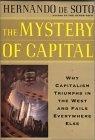
In this book, the main argument that de Soto made is he found a mystery of why capitalism only can bloom in the West. When capitalism penetrated to every corner of the world, scholars found that capitalism withered in most of place and want to find the answer and cure this problem. Hernando de Soto is one of them. Unlike other scholars, he argues that the main reason that capitalism cannot bloom outside the West is not because people in other places are lazy, or because they are not protestant so they don’t have those kinds of ascetic attitude to face their businesses. It also is not because all non-westerners are lazy or there are some blindness rooted in their cultural tradition that blocks them to be successful in modern capitalized market. He argues that the main question for these countries—including developing countries and former communistic countries—is laid on their legal system of property. According to he and his colleagues’ research around the world, they find that these countries actually have a lot of property which controlled by their poor people. Therefore, if these countries want to improve their economic condition and develop their countries. All they need to do is turning their legal system to be friendly to and more embodied in people’s daily need and their habit.
Generally speaking, I agree the main argument that the author made in this book, the formal property system is one of the most important things in market-based society in modern sense[1]. Without formalizing property, it would be difficult to count what people have, and that would be hard for people to exchange goods or property by monetary. de Soto clearly points out that the most important feature of capitalism is that everything has its own price, and this price is decided after comparing with other goods. In other words, he follows Marx’s doctrine that use value is not meaningful in market. It is exchange value that promises the blooming of capitalism. Also, exchange value is the reason for de Soto that why developing or former communistic countries need to establish a formal property system which is friendly and easy to included most of property in people’s hand as soon as they can.
However, there are several problems I want to discuss in this article. First of all, I think there is a problem which de Soto overlook in his premise. When he argues that it is not cultural differences that cause countries outside the West cannot develop capitalism well, I can see that he really want to against ethnic stereotype or some kind of racism arguments. He urgently wants to clarify that the failure in those third world countries is not based on a unique sort, on the contrary, it is because some universal things that they didn’t do very well. In other words, he tries to prove that the differences between third world countries and the West is not a fundamental difference, but a degree one. Just give third world countries some time and they can get better and better.
The author has a correct observation in this point without doubt. However, this cannot be an evident to support that the failure of capitalism in countries outside the West is not because their culture. Especially when he uses the evident that all merchants or vendors in the third world countries or former communistic countries work as hard as those in the West. He actually excludes any possible cultural differences between those merchants or vendors. Different cultural norm can direct its carries to the same termination. The same result cannot be an evident to support the same cause. In other words, diligent vendors that split around the world cannot be an evident that the capitalism fail in the third world countries or former communistic countries. In other words, an alternative argument can be made and it is still workable when discussing about the failure of capitalism outside of the West, that is all countries has its own cultural reason to block them succeed in develop the capitalism in their own nations.
In other words, I argue that the author is over reducing phenomena around the world. He over simplify the reason why capitalism cannot penetrated and rooted in the third world and former communistic countries. This will undermine his effort to certify the importance of formal property system in any country that in his list. For example, the capitalism couldn’t develop very well in China during the late 19th century and early 20th century. However, this didn’t mean that there was no formal property system existed in China. On the contrary, the measurement technics and the recorded method had been developed thousands of years in China. Each dynasty regularly measures and records the land, property in every household. Although we can argue that even under such kind of survey, there must exists extralegal area in China which would be definitely truth, but the extralegal area might not be a big issue for Chinese economic when Chinese encounters capitalism in the beginning.
In contrast, the reason that block Chinese to develop capitalism probably is laid on their cultural domain. It is their ethnicity ethos that always emphasizes on studying and becomes a successful officer can achieve higher social status than farmer. And a farmer should earn higher status than a merchant. In other words, it is this ranking system of occupation that might block or at least, discourages people to involve in commercial pursuits. de Soto doesn’t discuss this possibility in some countries which have their long term history. Even more, he ignores those countries’ history. Here, we can borrow the same argument which Eric Wolf made in his book to criticize the Western point of view: all people who live outside the West are people without history.
Again, this cannot be good for an analysis because when treating people who have their own history as none. It is an over simplify mistake that the author made. This situation will also undermine the author’s argument. If the extralegal economic activity is a pan-global phenomenon, then it might have different appearance and cause in different area. That will prevent the author to dig deeper into the ground of real life.
The last thing I would like to argue here is that the author misuses the concept of capital in Marx’s sense. For Marx, capital is totally an abstractive concept. Human creates capital by exploiting nature and producing different types of commodities to satisfy daily need. He argues that all commodities have two different values, one is use value and another is exchange value. The use value is the value that related to a product’s raw material and its physical characteristics, but the use value is not the thing that Marx really concerns, it is the exchange value that is the thing Marx focusing on. In his discussion, the exchange value doesn’t have a physical based because the exchange value is created during the labor process. It is human labor including the labor time and labor quality that creates the exchange value. Since the exchange value is the thing that measures the value of a commodity in market. It is also the source of the capital. To be short, in Marx sense, the accumulation of capital is not necessary related to the physical property because all the exchange value is not created from raw material or natural resource but from human effort.
In this notion, we can see that the author does not share the same capital concept with Marx. For de Soto, he uses the concept of property to replace the concept of capital. As he says:
Property is not the house itself but an economic concept about the house, embodied in a legal representation. This means that a formal property representation is something separate from the asset it represents.
(de Soto; 2000; P.50)
Property for him is an equal concept as capital for Marx. However, he still uses the capital at the same time and believes that formalize the property representation can help to create capital. In this regard, what he considers about the capital is nothing more than a representative system. Capital only occurs and can be accumulated after everything represented correctly by official record, it is nothing correlated with human labor. It is hard to persuade me that capital is a concept can be only located at the symbolic domain without considering any human labor.
I’m not arguing that formal legal system is not important when a country which wants to capitalize its economic, but over-emphasizing the symbolic aspect of capital might encourage the author to overlook several crucial factors that cause poverty. For example, it encourages the author that after a country establishes a formal property system which is friendly to most of its people, and then the poverty problem can be diminished automatically. This is not a case that happens in real world.
To sum up, I generally agree with the author that formal legal system for recoding every detail of property is an important factor in those countries which struggling to record the property on their land. I also agree that there is more mental effort need to be done than the physical one. However, considering that the author ignores some historical factors, cultural differences and over reduction of phenomena. I cannot agree with him that the formal legal system is the main issue that we should concern. And also, the mystery of capital is not only hidden behind history of the West, but is in the fracture of world history. [1] It is worth to mention that, here, I use the market-based in modern sense is comparing to Karl Polanyi’s argument—market appears in human society earlier than capitalism for a long time, therefore, we should separate these two concepts instead to see that market based society is a by-product of capitalism.